Altikar (Nation)

The Third Republic of Altikar
Born, Fought, Lived.
General Information
| Capital | Lavasa |
|---|---|
| Official Language | Altikboli |
| National Language | Altikboli |
| ---- | ---- |
| Demonym | Altikar |
| ---- | ---- |
Other Names
The Helmet of Multavia
Government
- State Government
- Chancellor: Luca Vardhan Sharma
- Legislation
- Upper House: Senators
- Lower House: House of Representatives
Economic Data
| Year | GDP |
|---|---|
| GDP (nominal) | 10.13 Trillion Rupa / 22,000 trillion USD |
Other Information
Establishment: 1971 AD
Currency: Rupa
Time Zone: Eastern Wasaru Time
Drives on the: Right
Calling code: +67
Internet TLD: .alt
Overview
Protected by the Kolsik mountains in the south, and the lush forests of Central Wasaru (Landmass) in the east and west, lies the young Republic of Altikar. A democratic nation of 236 million Altikarians, it was previously a part of the Federation of Multavia, having recently gained independence in 1971. It is bordered by Kjanu (State) of the United Kingdom States (Nation) in the west, The Afzhizstan (Nation) in the south, Verleschdie (Nation) in the north west and Solare in the east. It is currently in the Second Age of Calamity, which is a time period commonly used to describe a decade of conflicts and an increased death rate in Multavia, the first one having occurred nearly 50 years ago in 1969. For the large fraction of its small history, Altikar has been democratic, exceptions being small periods of instability and regime changes. Having recently escaped an era of continuous civil conflict, the Third Republic was established with a new chancellor. It is commonly at odds with geopolitical rival Afzhizstan, due to historical events. Both nations have faced many conflicts with each other, with the latest one being in 2024. Altikar has been primarily a resource extraction economy since its foundation, using the rare earth deposits and precious metal reserves to its advantage. The nation also has a developing Information Technology sector, with recent Profitist governments promoting the tertiary sector. Altikar also has a heavily developed weapons industry, with excellence in Aerospace Technology and Naval Manufacturing.
Etymology
The word Altikar can be divided into two root words, 'Altik' and 'Ar'. Altik was used to reference the Altik river that flows across the Altikarian lands, and 'Ar' is the ancient Multavian word for 'Land'
Therefore, Altikar translates to 'The land of the Altik', used prominently by Qurellon and Tighal traders.
Geography
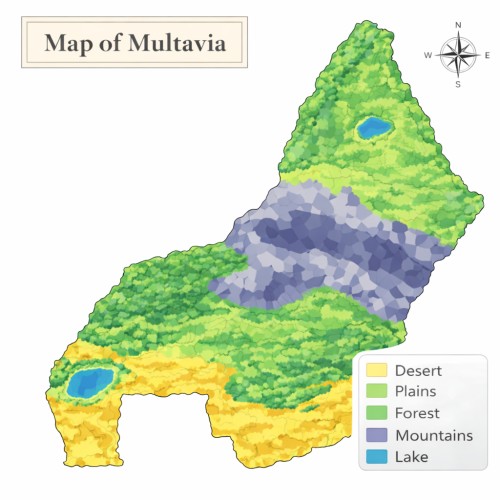
Altikar is not as geographically diverse as its neighbours, primarily having two biomes. The cold jagged mountains of the north, named the 'Kolsik Mountains', are the source of Altikar's 6 major rivers. In the south are the Altikarian plains, bordered by the Kjanuan rainforests in the west and the Solarean forests in the west. Altikar has many lakes too, with the largest one being Lake Lavasa, on which the capital city is situated.
The six rivers of Altikar are the Kalyani, Sarjuvan, Brajdhara, Rohitva, Altik and the Belani. The largest of these is by far the Altik river, which flows along the western border of Altikar, through Tetsone into the Sea of Fides. All these rivers are particularly rich in fauna. A very famous animal that lives in the Altik River is the Altik Dolphin; previously an endangered species, which has now been revived due to conservation efforts of the Methi government in 2002.
Altikar has many interesting native species, such as the Altikarian Elephant, the Kepsik Tigers, and the Altikarian Lammergeier, which is also the national animal.
The only coastline Altikar has is on the Sea of Fides, which is known to be a very turbulent strait due to its strong currents. However, in modern times with technological advancements, it has become a great source of revenue for the Altikarian population due to the presence of fisheries. The quality of these fisheries is also superior to that of many other locations due to the strong current of the Sea of Fides, which stirs up nutrients. In 2004, Oil was struck in the very same waters in copious amounts. However, in a controversial decision, its extraction is not yet legal as per the Environmental Protection Act (2004).
The Kolsik Mountains in the north are glacial mountains with numerous mineral resources, including neodymium and dysprosium. Aside from minerals, the Kolsiks are the foundation for Altikarian water sources, thanks to the numerous rivers that flow from them.
Demographics
Founded based on religious divide, Altikar is demographically very homogenous, with over 80% of the population being Hindu Altikarian Multavics. Despite this, over 4 decades after it's founding, several minority communities have sprawled in various parts of the country, mostly due to spillover from it's neighbors. In the North East, the urban cities of Indoore and Aurangabad are dominated by the 'Varcan' ethnic group who are descendants of Praefectian merchants settling in North Eastern Altikar.
Out of all Altikarian cities, Poona (Formerly Tetsone) is the most culturally diverse. As the country's financial backbone, and till very recently it's political center too, Poona is a melting point of various cultures. Tetsone has a sizeable immigrant population of Koheni, Kuzikstanian and Novoroyskan peoples, along with some other wasaruan nationalities. However, the 20s have seen a major decline in immigration, due to civil unrest and conflict throughout Multavia.

Language
English is the most spoken Altikarian language, due to it being widely accepted as a global language in Utopia. In 2008, Altikar had 100% of it's population knowing how to read, write and speak in English fluently due to rigorous education programs promoting it as the primary language, keeping Altikboli at a secondary position and discouraging most regional dialects.
Religion
Hinduism is the most followed religion in Altikar at 50% followers, however has faded in followers over the years due to modernization and immigration. As of 2025, Atheism is the fastest growing religious belief in Altikar, with 49% of the population being Athiest.
Government
Altikar is a federal republic operating under a synchronized election system. It combines a bicameral legislature with a strong executive that is still constitutionally constrained. The judiciary is an independent body ensuring proper working of the government and interpreting the constitution.
Executive Branch
The executive branch of the Altikarian Government is led by Chancellor, who serves as the head of the government and commander of the armed forces. Elected through a popular vote, The Chancellor’s responsibilities include implementing legislative laws and directing domestic and foreign policy. The Chancellor is supported by a cabinet of secretaries leading different departments with different jurisdictions (Department of Internal Affairs, Department of War).
Legislative Branch
The Altikarian Legislative Branch is a bicameral congress composed of the House of Representatives, and the Senate. It is responsible for drafting, debating and passing laws, approving budgets and keeping the executive in check.The legislature also holds investigative powers and confirms key appointments, reinforcing checks and balances.
House of Representatives
The House of Representatives is the lower house of 250 members, with provinces’ share being proportionally accurate to their population. It is the primary legislative body, with authority over budgetary process and initiation of legislation. Furthermore, representation is periodically adjusted to match population changes.
Senate
The Senate is the upper house of 20 members, equally divided between 2 senators for each province. The House reviews, amends and ratifies laws passed by the House of Representatives. The senate also ensures that regional interests are secured in policymaking, and more populous provinces cannot dictate policy.
Judical Branch
Altikar’s judicial branch is an independent system responsible for interpreting laws and upholding the constitution. Headed by the Supreme Court of Altikar in Lavasa, it is a federal system of smaller local courts such as Province Courts and District Courts. The Judiciary exercises judicial review and interprets the constitution.
Supreme Court
The highest body in the Judicial system and also the final interpreter of the constitution is the supreme court. Located in Lavasa, the new capital of Altikar. The Supreme court also settles disputes between different government bodies. Comprised of a Chief Justice and associate justice that usually serve long terms to prevent political influence.

Elections
Altikar follows a synchronized election cycle, where the entirety of the Congress and the Chancellor get elected every 5 years. However, due to the recent reintroduction of this system, the current congress and Chancellor will have to face midterm elections in 2027. In between the election cycle, occurs the Midterms. The midterms are smaller elections designed to test public sentiment and approval for the government. However, only a fraction of the sitting government contests the midterm elections. The House of Representatives is divided into three classes of A(83 seats) B(84 seats) C(83 seats). Every midterms these three cycles rotate to be contested based on alphabetical order. Therefore, in the 2027 midterms the Class A seats will be contested. Similarly, over half of the senate contests the election, divided into the Northern States and the Southern states, that alternatively rotate contention during each midterms.
Economy
Before 2021, Altikar maintained a high growth, export driven economy built on extraction of raw materials such as petroleum, precious metals and rare earth metals, positioning the country as a major player in the global energy market and advanced manufacturing supply chains. These sectors have financed the nation’s technological progress since independence and have contributed towards Altikar’s social programs and quality of life.
In the previous two decades, Altikar has seen a major growth in the IT and digital service industries, supported by an educated workforce and government incentives. This has contributed to a growing middle class and integration of the Altikarian economy into the global market, and contributed towards the end of Altikar’s reliance on commodities.
Industrial production is concentrated in the northeastern provinces which were previously Peromek. However, economic inequality is seen in the south where the fruits of development have yet to be seen in the rural areas of the Kepsik highlands and mountains.
An interesting industry that also owns a sizable part in the Altikarian economy is the fishing industry of Altikar. Dominated by the Varcan people, the strong currents of the sea of fides allow for nutrients to stir up in Altikarian fishwaters, resulting in a better quality of fishes compared to neighbouring waters.
Agriculture
Altikarian agriculture was a booming industry during the era of the Multavian Federation, where Altikar was virtually the bread basket of Multavia. This was due to the presence of fertile soil and adequate irrigational facilities contributed by the six major rivers of Altikar. However, after Altikar’s independence from Multavia in 1969, agriculture slowly decreased in volume, however it still supports the nation and meets the requirements of the population.
The major crops grown in Altikar are rice and pulses, which are also the primary staple foods of Altikar. Cash crops are limited to very small areas, mostly being cotton and sugarcane.
Technologies
Altikarian technology saw a boom in manpower after Kilamehi scientists start fleeing to Altikar for refuge after the Multavian Civil War. Most Altikarian governments have invested heavily in defense technologies, to gain an upper hand against Afzhizstan in conflicts, which has proven successful to the point where Altikar could be considered a regional power, however still behind the likes of the United Kingdom States (Nation), The Kohen and Meridia. The Altikarian defense industry is categorized by production focusing on technological prowess rather than volume.
Kilamehi brains have also contributed to the advancement of fields such as AI, Biotechnology and Space research being prominent in Altikar.
Religion and Culture
Founded on religious differences, Altikar has a clear majority of Hinduism, a religion that is not a fixed doctrine but a civilizational framework of thoughts and practices. It is not rigid and linear but up to the interpretation of the individual, which allows multiple iterations of the faith believing in multiple gods and multiple practices. It is a very decentralized faith which allows for unity and diversity at the same time. This is evident by various sects and schools of Hinduism in Altikar.
Infrastructure
Altikar as a nation is very urban centric due to the small size of the nation hosting a big population. Despite this, privately owned vehicles are NOT the norm in urban centers. This has been made possible by the Green Party’s infamous administration from 2004-2016, Where several bills were passed to make public transit the primary mode of transportation for Altikarians, and reduce carbon emissions which were already prevalent due to the Altikarian reliance on conventional fuel. Altikarian cities are interconnected by a massive network of underground hyper speed railways and subways, which make work migration unnecessary. Furthermore, a complex system of trams and metros are built in cities for easy transit. The green party’s Magnum Opus of public transit can be seen in the city of Lavasa, which has possibly one of the largest and most intricate subway systems in the city designed to be a polycentric star.
In rural Altikar too, roads and electricity infrastructure has been perfected by the late 2010s, however taken a heavy toll due to the multiple years of war in the 20s. The Kepsik highlands too have been connected to mainland Altikar by a system of roads, railways and cable cars, making tourism in those areas possible.
Energy
Altikar has been a country completely reliant on natural fuels like oil ever since its foundation. This was due to decades of negligence of clean energy infrastructure by the Multavian Federation, simply due to the abundance of natural resources in the Multavian deserts. However after Altikar’s independence it became difficult for Altikar to keep up without oil from Afzhizstan. This changed after a large deposit of oil in the Sea of Fides was discovered in 2004, having the potential of Altikar’s oil reserves matching that of Afzhizstan. However, the Environmental Protection Act, a comprehensive act passed by the Green Party’s administration in 2004 made Altikar pivot to clean energy instead, striving towards aggressive expansion of nuclear and clean energy to all parts of Altikar.
Hence, the Altikarian reserves present in the Sea of Fides have not been up for extraction for over two decades. All oil that Altikar gains from its previous sources are exported to other parts of the world to countries like Jadefall and Impeck, under the Republican Oil Fund. The Oil Fund strictly directs the profit gained from oil exports towards infrastructure,
Creator's Notes
Despite Hinduism being the primary religion of Altikar, the caste system does NOT exist. It exists only in a very small sect located in some random village in the Kolsik Mountains, however it has been rejected due to the Manusmriti not being adopted as a religious book during Hinduism's rise.
Provided by Dave(User)