War of the Third Coalition (Conflict)
Part of a Series on Global Conflicts

Information
| Date | 15th 1913 - February 25th 1919 |
|---|---|
| Location | Wasari (Landmass)・Wasaru (Landmass)・Dissopoloforia (Landmass)・Glestonoph (Landmass)・Obsidian Isles (Landmass) |
| Result | Coalition Victory |
Belligerents
| State of Kkhano | Third Coalition |
|---|---|
| Kkhano (Nation) | Impeck |
| ⠀ | Kjanu (State) |
| ⠀ | Meridian Commonwealth (Nation) |
| ⠀ | Grenopia (Nation) |
| ⠀ | Italian Canada (Nation) |
| ⠀ | Aretnorf (From August 1913) |
| ⠀ | The Soviet state of Svalbard (Nation) |
| ⠀ | Nordic Democratic Republic (Nation) |
| ⠀ | Jadefall |
| ⠀ | Continental Bureau for Highsteppe Liberation (Organization) |
| ⠀ | Multavian Shadow Council (Organization) |
| ⠀ | All-People's Army for Liberation (Organization) |
| ⠀ | Jääger-movement (Organization) |
| ⠀ | Co-Prosperity Treaty Organization (Organization) |
Overview
The War of the Third Coalition was a global armed conflict between the Empire of Kkhano and the secret alliance (usually referred to as the Coalition or the Allies), which contained most other independent countries in Utopia at the time. The war saw combat across almost all of Utopia with most continents and oceans becoming battlegrounds at one point; Shanting and the uninhabited Tramuntana were the only continents to not see combat. The pressures of the war necessitated a rapid advancement in military thinking and technology: artillery firepower and cavalry charges gave way to armoured combined arms and aerial warfare; these shifts were aided by the introduction of new weaponry such as machine guns, tanks, aircraft, and chemical weapons. The war was one of the deadliest in all of human history, with an estimated 80 million military casualties along with around 12 million civilian deaths from displacement, genocide, or war-related causes.
Factors that contributed to the outbreak of war in 1913 include the internal instability of the Empire of Kkhano which fed nationalist and revolutionary sentiments, fear of integralism, revanchist sentiment amongst the remaining independent states, and an increasingly escalatory arms race between Kkhano and the Coalition. The tension brought on by these factors came to a head in December 1912 when a rebellion in Kkhanoese Kerület No.40 forced the Integralist regime, under pressure from Impeck, to hold a referendum on the future of the territory. The territory superficially voted to remain with Kkhano, however numerous irregularities occurred during the referendum which was heavily reported on by the press in members of the Coalition. The sham referendum instigated further protests from the population in the Kerület which rapidly spiralled into further violence, until eventually Kkhanoese governor Coro Ma-Qa-La was assassinated by Impeckan nationalist Mwanza Dzongo. Kkhano blamed Impeck for inciting the violence and began mobilising in January. War was declared in February, with Impeck calling upon the aid of the members of the Coalition most of whom promptly joined the war.
Kkhano planned to eliminate coalition members one by one in a series of rapid invasions, amassing large forces and pushing deep into Impeck and the Meridian Commonwealth. Despite capturing substantial swathes of territory, these offensives failed to achieve decisive victories against either nation thereby allowing other nations to fortify and solidify their own frontlines. By the end of Summer 1913 thousands of kilometres of trenches had been dug between the borders of Kkhano and coalition members; although some fronts such as those in Norðen or Meridia remained more dynamic, neither side was able to gain a decisive advantage for years resulting in the static warfare the war is most well known for.
A triumvirate of more hesitant members of the coalition including Jadefall, Svalbard, and the Nordic Democratic Republic joined the war in the Autumn of 1913 when the coalition’s collapse no longer looked imminent. For the next two years Kkhano made a gradual series of major victories such as defeating a major Hungarian uprising in April 1914; the capitulation of the Nordic Democratic Republic in July 1914; and the capture of Progress in May 1915. These victories proved insignificant in the grand scheme of the war as Kkhano’s military and administration continually deteriorated under the strain the war had put on it.
A combined coalition force met the Kkhanoese navy at Cape Pop in November 1915, decisively defeating it and thereby straining Kkhano’s ability to supply and communicate between the overseas territories of its empire. In the Spring of 1916 Kkhanoese offensives were launched across all fronts in a desperate attempt to regain initiative in the war; despite initial successes these ultimately left Kkhanoese forces demoralised, overextended, and out of supply whilst failing to meaningfully hurt the allies. After this the coalition partook in a series of offensive operations to knock out Kkhanoese strongholds across the world and therefore allow them to pool their forces together in a unified front: first Glestonoph in the Summer of 1916, then Dissopoloforia in the Winter and Spring of 1917, the Obsidian Isles through the Summer of 1917, and finally Wasari by the end of 1917 — few battles were fought in the operations as most Kkhanoese forces had been expended on the offensives of the previous year. Kkhanoese forces continued to defend Wasaru for another year, but could not withstand the combined forces of the Coalition and were forced to surrender after the fall of Syr Dárya on February 25th 1919.
The Titel Peace Accords organised the collapse of Kkhano and established a new global order. The most influential victorious powers assumed responsibility for managing the vast majority of the former empire’s territories, organised in the Procuratorate system which led to the vast expansions of Grenopia, Italian Canada, Kjanu, Impeck, and Jadefall. Territories that did not fall under the purview of these procuratorates were divided between former rebel groups, leading to the re-establishment of nations such as Northern Czech, Novoroyska, Tlanyuca, and the Thanedom (among others). This system established the victorious powers as dominant players in the postwar world with the intention of them using their newfound strength to maintain world peace and suppress global integralist sentiment — instead competition quickly arose amongst the procuratorate powers, and this combined with dissatisfaction with the treaty by many parties contributed to the numerous major conflicts of the 1920s.
Background
International Stagnation and Integralism

After the fall of the Serene Republic of Trondelang in 1636 until the beginning of the 20th century the world of Utopia went through a period of stagnation. This period of time has been dubbed various names by historians such as ‘The Age of Absolutism’, ‘The Modern Dark Ages’, or ‘The Great Stagnation’ and was characterised by nations globally having a penchant for autocratic rule, socially conservative values, mercantilism, and imperialist expansion. Although these trends manifested differently across the world and to various extents these factors contributed to a global downturn in development, growth, and international cooperation.
These factors combined to create a general feeling of resentment amongst the lower classes whose quality of life improved marginally over a long period of time in spite of the superficial advancements their leaders were making through the establishment of empires. Armed conflict was also prevalent in this period: expanding imperial states such as the Empires of Jadefall, Electrica, Kuzia, Miotia, and Candor tended towards aggressive policies both to conquer weaker states and to win competition against imperial rivals; civil unrest was also prevalent in certain parts of the world with the War of the splintered states in Svalbard, Wars of unification in Italian Canada, and communist revolution in Norðen among others contributed to declining international stability.
This period of great stagnation set the stage perfectly for Kkhano’s rise to begin in the middle of the 19th century: low growth for two centuries meant Syr Dárya had been able to quickly catch up to and surpass the strength of their contemporaries; integralism as an ideology appealed to the downtrodden and marginalised who accounted for the vast majority of most nations’ populations; and internal conflicts and imperial competition made resisting Kkhano or presenting a united front against them difficult. Organised resistance against Kkhano both inside and outside their empire was very rare up until 1910.
The Arms Race
Kkhano experienced rapid economic and industrial growth both before and during their expansion. Successive directors of state sought to use this growth to rapidly and continuously expand and modernise Kkhano’s armed forces; this policy was guided by the philosophy of Gunyar general Mátyás Tiebold who argued in his book ‘Integralism in practice’ that in order for integralist expansion to be sustainable then vast sums of money will need to be allocated to the military, and for this spending to be sustainable then the military must be used to conquer new territories which will further expand the economy. This would therefore create a virtuous cycle of growth and expansion wherein past conquests will fund the growth of the military in order to conquer new ones.
The extent to which Kkhano mobilised resources and the efficiency with which they did so to this end was unthinkable and impossible at the time for the vast majority of nations. Most also did not see an incentive to match the Kkhanoese military build up when, in their perspective, Kkhano was a regional power in northern Wasaru who was unlikely to ever come into conflict with them. These attitudes began to change in 1874-80 when Kkhano expanded rapidly across southern Wasari, demonstrating their ability to project force outside of their home region thereby becoming a global threat.
The global arms race is largely believed to have begun in 1897 when Kkhanoese forces stopped advancing at the border of Italian Canada and Grenopia. This development prompted both nations to make efforts towards preparing their military’s for conflict with Kkhano: Affeo Turrenet in Grenopia expanded the powers of the presidency to streamline the recruitment process as well as initiating an expansion of Grenopia’s defense industry; meanwhile Italo-Canadian president Valentino Mangiapane introduced compulsory military service and approved a project to improve and modernise the fortifications along the nation’s western border.
These efforts were followed by other nations such as Svalbard in 1901 and Jadefall in 1905 both of whom instigated a naval arms race against Kkhano along with the ongoing land-based race. Trondelang and Lurilmo spent vast sums of money to rapidly expand their navy between 1901 and 1913 but could never hope to match the output of Kkhano’s globe spanning empire. Despite this Kkhano fell behind both technologically and although they maintained a production advantage until the outbreak of war their navy was made obsolete by the launch of the SRN Capricorn in 1910. Exact numbers are difficult to ascertain but it is estimated the independent powers of Utopia increased their military spending by over 75% between 1897 and 1913 whilst their military’s expanded by over a million personnel.
Kkhanoese Instability and Decline
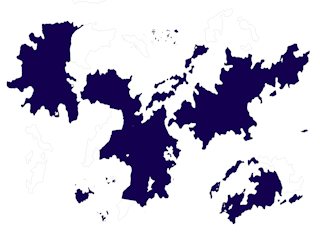
Although Kkhano’s last war of expansion ended in 1910 cracks in the system had become obvious as early as 1890. The Verleschidian expedition which began in 1880 had intended to conquer the remainder of Wasaru that had yet to fall under Kkhano’s domain yet faced unexpected struggles due to poor logistics, culminating in the state suffering an embarrassing failure in their inability to occupy the entirety of The Kohen.
This setback was traumatising for the leadership of Kkhano — the state had spent too many resources on the operation and saw insufficient returns for it. For a state whose existence was predicated on continuous success any kind of failure was unacceptable and this resulted in bitter debates occurring throughout the Kkhanoese government on what, if any, reforms were necessary to prevent such a disaster being repeated. These debates would morph into a power struggle between various factions inside Kkhano, and although at first the effects were limited and the Kkhanoese military continued to see success the struggles would eventually seep into the rest of Kkhanoese society. The turn of the 20th century saw a significant uptick in resistance activity against Kkhano as the quality of life under Kkhanoese rule began to stagnate and the military struggled to suppress rebellious people.
Kkhanoese instability hit a fever pitch during their final aggressive operations during the Great Leap Forward (1899-1910). Although the integralist empire was largely successful their military struggled mightily against inferior opposition and ultimately failed to fully subjugate northern Dissopoloforia as had been intended, with a handful of Jadefallian strongholds on the continent withstanding Kkhanoese invasion. The previous two centuries of decline were exemplified when, as Kkhanoese troops moved into Fort Franenburg, a rebellion in Catabola rapidly grew out of hand and saw most of Kerületek No.41 secede. With the army largely preoccupied on the other side of the planet the integralist government had to make a hasty ceasefire with the Impeckan rebels to avoid losing more territory.
The success of this rebellion encouraged anti-Kkhanoese sentiments both in and outside the empire — Kkhano hadn’t looked this vulnerable since 1773 and many argued that if they were to be stopped the rest of Utopia had to take action now before it was too late. This optimism was quickly curbed when a series of sporadic rebellions throughout Kkhano were brutally crushed; these events led to the realisation that Kkhano in spite of their weaknesses was still too strong to be defeated alone. This mentality was officialised at a meeting of independent states (aside from Kkhano) in the Italo-Canadian city of Genovina in 1911: in which all nations present aside from Jazkovn, Quziq, Svalbard, Jadefall, and the Nordic Democratic Republic agreed to form a defensive pact against Kkhano — although the latter three of the non-signatory nations agreed to not interfere with any actions taken to weaken Kkhano by the alliance. Aside from ensuring their own survival the remaining independent nations also held an interest in orchestrating the downfall of Kkhano to expand their own influence in the world.
Prelude
Rebellion in Mbanza-Kongo
In November of 1912 the 14th Kkhanoese army was relocated to the Aretnorfian border from Kerület No.40. Although the army’s primary purpose was to garrison the border with Impeck it also served as a deterrent against further uprisings in the region inspired by the successful one in 1910 and had been kept there since this event. This significant decrease in the Kkhanoese security presence buoyed the confidence of rebellious elements in the Kerület, a feeling that was bolstered by material support from secret military societies inside of the independent Impeck, notably the extremist ‘156 Movement’.
Local anti-integralist partisan Hermann Mu-qa-ba instigated an uprising in the city of Mbanza-Kongo on December 3rd 1912 with the aim of unifying Kerület No.40 with the independent Impeckan state to their south. Mu-qa-ba’s rebellion had momentum for a couple of weeks with notable figures such as Zohra Mbutu — leader of the 156 Movement — joining in along with other northern Impeckan towns such as Longonjo falling to secessionist rebels. Progress for the rebels after the first week was minimal however: the other ethnic groups of Kerület No.40 (mainly Corlenians, Nymfi, and North Kjanuans) had little interest in joining when the rebellion had explicit Impeckan sympathies; other independent countries were hesitant to throw their support behind the rebellion due to its limited scope and likelihood of Kkhanoese retaliation.
Historians have described the Mbanza-Kongo rebellion making ‘little to no impression on the vast majority of people at the time’ as life continued as normal outside of the affected Impeckan cities. Despite this the mood in Hadano (the administrative capital of Kerület No.40) was bleak: integralist governors feared a repeat of the events of 1910 with the military otherwise preoccupied.
Plebiscite scandal
Being unable to rely on violence but unwilling to surrender wholly to the rebellion the governors of Kerület No.40 opened negotiations with the rebels. Under advice from the central government in Syr Dárya governor Coro Ma-Qa-La offered the rebels a referendum on their future, hoping that a Kkhanoese victory at the ballot box would subdue most Impeckan resistance. The referendum was intentionally designed to be unappealing to the Kerület’s population: the only options were remaining with Kkhano or joining Impeck which the non-Impeckan populations were not enthusiastic about; the ballot papers explaining the referendum also espoused the benefits of remaining in Kkhano whilst warning of the potential consequences of joining Impeck.
Despite these efforts the Impeckan camp led by the 156 movement campaigned relentlessly, offering autonomy to minorities to get the other ethnic groups on side. The pro-Impeckan campaign was bolstered by covert support from the Impeckan government — the exact extent of this support is unclear, but its existence was uncovered by Kkhano soon into the campaign which restarted panic in Hadano once again. Afraid of the possibility of the pro-Impeckan side winning Coro Ma-Qa-La organised ways to rig the referendum in their favour, ultimately resulting in a superficial Kkhanoese victory.
Upon the results being announced there was notable unrest amongst the population of Kerület No.40, but violence was rare in the initial days after the vote. Suspicions of foul play were immediately raised though given how much harder the pro-Impeckan campaign fought and these suspicions led to tabloids across the world reporting on the (unconfirmed) rigged election. These news articles incited anger amongst the Kerület’s population, emboldening partisans to take more aggressive violent action against Kkhanoese collaborators. In response to increasing violence in major cities, governor Coro Ma-Qa-La believed targeted state visits in major cities could calm tensions, simultaneously reaching out to the people and showing the force Kkhano could still project. In his first visit to Masis though anti-Kkhanoese sentiment was far greater than expected; the security situation rapidly deteriorated out of control and during the chaos the governor was murdered.
January Crisis
The death of governor Coro Ma-Qa-La hardened minds in Syr Dárya; the fiasco with the plebiscite and subsequent murder of a prominent collaborator convinced most of the administration of the pressing need to crush subversive elements within the empire immediately. Despite having no concrete evidence of Ligul’s involvement in the death of the governor the Kkhanoese wished to use the situation as an excuse to reassert sovereignty over the lost Kerület No.41, believing that if they let this go they may never have a chance to do so again. On the 15th of January Kkhano delivered an ultimatum, demanding Impeck allow Kkhanoese security services operate in Impeckan territory in order to prosecute members of the 156 Movement under the pretense (without evidence) that they had orchestrated the murder of Coro Ma-Qa-La. The ultimatum expired in one month after which the Kkhanoese military would march into Impeck to forcibly conduct the investigation.
This action led to a flurry of diplomatic movement amongst members of the coalition with Impeck in particular wishing to secure the guarantee of support from as many of their fellow coalition members as possible. The Impeckans did not actually respond to the ultimatum during this time and publicly acted as if they were deliberating whether to accept or not; in reality Ligul was never going to accept, but the lack of clear public intent bought the coalition time to prepare. All members of the coalition eagerly supported Impeck save for Svalbard, Jadefall, and the USSNDR. These three nations hesitated as they were not immediately threatened by Kkhano from a land border and subsequently wished to pick a more opportune time to join the war.
Within Kkhano this month before the war saw an uptick in support for the integralist government: even though opposition to Syr Dárya’s rule was growing the murder of a high profile official was seen as a step too far amongst all but the harshest critics of integralism. Many more moderate anti-integralists reportedly switched allegiance back to the Kkhanoese government, seeing it as being able to safeguard against such politicised violence. Confidence also buoyed amongst many Kkhanoese elites during this month before the war — Impeckan hesitation to respond to the ultimatum confirmed beliefs of Kkhanoese superiority in Syr Dárya, confident that reforms to the government and military since 1910 would propel them to a swift victory.
Phases of the war
Initial Kkhanoese Offensives
Kkhano initially amassed their forces in three locations: in Wasari along the borders with Italian Canada and Grenopia; in northern Wasaru against Kjanu and Aretnorf; and in the south of Wasaru against Impeck. Kkhanoese preparedness caught the Coalition nations off guard and many had to scramble their defenses to repel the attacks with limited effectiveness. Kkhanoese victories in Wasari were limited thanks to fortifications built by the governments in Croopsvil and Cotajromm previously. In contrast offensives in Wasaru were far more successful: in the north Kkhanoese troops pushed into Buinon and as far south as Proec Flor, capturing Pivolin in the process; whilst in the south the Impeckans were pushed back to the gates of Ligul.
Panic in the Coalition
In the opening weeks of the war it seemed as if a Kkhanoese victory was imminent, the prospect of which set off alarm bells amongst the political and military leaders of the Coalition. Many members of the anti-Kkhano alliance had anticipated that they would be able to launch offensives akin to those undertaken by Kkhano, however unaware of the extent of Kkhanoese preparations these plans were months away from being ready to launch.
The fear induced by early Kkhanoese successes pressured some nations into activating their offensive plans despite the reservations of more cautious members of their general staff. These hastily prepared, under-supplied offensives predictably failed to achieve any meaningful victories: Meridian offensives into Khorasan achieved negligible territorial gains at disastrous human cost, failing in their larger objective to dislodge Kkhano from northern Glestonoph. Koheni plans to recapture the island of Vershaia were subsequently shelved in the aftermath of this and previous Kkhanoese offensives, Kaliciya having realised that the necessary material assistance from other coalition members would not be forthcoming in the current state of the war. The Wasaruan island nation consequently would be restricted to defensive warfare for most of the conflict; in 1914 the battle for The Kohen would also see Utopia’s first instance of anti-aircraft warfare when a Kkhanoese biplane was shot down over Akatra.
The Onset Of Trench Warfare
After the initial shock of Kkhano’s early offensives wore off the Coalition adapted their tactics to suit a defensive war. Barbed wire was laid across the length of most frontlines whilst machine guns and artillery bombardments came to be used as a standard by most nations. This tactical adjustment allowed all frontlines to become largely stabilised; most notably allowing the Impeckan army to break the siege of Ligul thereby halting Kkhanoese advances into Impeck and securing a major win for the Coalition.
Realising their infantry-centric offensives were no longer viable the Kkhanoese adapted in kind, adopting the same defensive strategies as their opponents had done. By 1914 trenches had been dug on both sides of the frontlines across almost every front, giving the war the glacial pace that it is now best known for. Throughout the war various attempts would be made to forcibly break through these entrenched lines, most of which would by and large fail and often at heavy human cost. Some of the deadliest battles from this phase include the Kkhanoese Akoto campaign (February 1913-August 1913), the battle of Atsushio (March 1913-October 1913), the Sniasia offensive (September 1913-May 1914), the Savoie campaign (March 1914-August 1914), and the amphibious landing at Mayrg (December 1915-July 1916). On top of this, disease was a major cause of death throughout the war as conditions in trenches were rife for the spread of illnesses; outbreaks of trench foot, typhus, and flu were commonplace on the frontlines of both sides.
Entry of the Arctic Islands into the war
With the advancement of frontlines slowing in mid 1913 the focus for the Coalition turned to how to break the stalemate. In the current state of affairs a long, drawn out conflict favoured the Kkhanoese who could leverage their overwhelming industrial and resource advantage to outproduce the Coalition, gradually taking down each individual member one by one: for their part the coalition hoped Kkhano would become spread too thin, unable to manage every front at once and slowly succumb to logistical failures inducing internal rebellions. At the present moment though the Coalition lacked the force of arms necessary to carry out this strategy, as without a sizable naval force of their own the Kkhanoese navy could act virtually unimpeded and guard their global supply routes.
This reality forced the coalition to go on the diplomatic offensive to attempt to coax their uncommitted allies of Jadefall, Svalbard, and the USSNDR into the war. For their part hesitation to join the war on the part of the Obsidian Isles nations had proven smart following the Coalition’s initial ineptitude, but with the frontline stabilising in April pressure was mounting on Lurilmo, Trondelang, and New Leningrad to follow through on their prior commitments.
These developments did not go unnoticed in Syr Dárya, however Kkhanoese leadership was not convinced it would have a significant impact on the war so did nothing to deter the three Arctic nations from joining the war. Instead Kkhano sent their most experienced units and reassigned their most competent generals to Glestonoph in order to further their current objective of defeating the isolated Meridian Commonwealth. Kkhano’s ambivalence to these developments can largely be attributed to a phenomenon now dubbed the ‘Spirit of 1913’, wherein support for the integralist government was at an all time high and the leadership’s confidence was teetering on arrogance; these feelings were largely thanks to early successes on the battlefield by Kkhanoese forces.
Diplomats from Jadefall, Svalbard, and the USSNDR met in April 1913 to agree on a joint plan for joining the war, giving themselves four months to prepare before entering together. When August came the three nations issued a joint declaration of war against Kkhano and began their operations: Svalbard sent the bulk of their forces to reinforce the Grenopia-Italian Canada front, whilst a smaller detachment would slowly invade the Askala Islands; the USSNDR invaded the Meji and eastern Askala Islands; meanwhile Jadefall landed in various locations in Dissopoloforia to spread Kkhanoese forces more thin.
Naval and Air Campaigns
As the Winter of 1913 approached activity on the frontlines in the northern hemisphere, already rather low, ground to a near complete halt as mud and snow compounded with pre-existing factors made it near impossible for either side to advance. With land combat out of the question as a way to break the stalemate, the coalition had to look to other strategies. As they had just gained Utopia’s three largest navies not owned by Kkhano the focus now shifted to how they could use this asset to their advantage.
The Svalbardian Royal Navy and Jadefallian Imperial Navy initially attempted to blockade key Kkhanoese ports in order to cut off supply lines at the source. This strategy however left coalition fleets vulnerable as they needed to split up to blockade a sufficient number of ports to have any significant impact, whilst the Kkhanoese could pool their forces together and overwhelm the blockading fleet.
By the Spring of 1914 Trondelang and Lurilmo recognised their strategy needed to change and subsequently abandoned most attempts at blockading; they instead shifted to a hit-and-run style of warfare to harass and interfere with Kkhanoese shipping routes. This shift saw an increase in the usage of submarines, whilst any Kkhanoese escorts could easily be overwhelmed by the coalition’s superior technological edge. These efforts were markedly more effective and contributed significantly to Kkhano’s offensives slowing down between the Summer of 1914 and Winter of 1915.
The naval war came to a head in November 1915 when a small contingent of the Svalbardian Royal Navy baited the main Kkhanoese task force into taking an engagement around Cape Pop. Unbeknownst to the Kkhanoese the Svalbardians were leading an international task force of other navies and took them into the battle with them, completely overwhelming and destroying most of the Kkhanoese fleet. After this battle the Kkhanoese navy could never again project power in a meaningful way, giving the coalition free reign over international shipping lanes.
1914 also saw the beginning of large scale bombing campaigns against Kkhano: in an attempt to weaken the empire’s capabilities in the absence of advancements in the ground, countries with large airforces such as Jadefall and Impeck began launching raids on military and industrial targets inside the empire of Kkhano. Zeppelins and byplanes were most commonly used during this time, and although the damage they could inflict in individual attacks was limited over time the devastation caused by these operations left entire cities in ruins; particularly north Wasaruan industrial centres such as Miotius, Buda, Velvetia, and Syr Dárya suffered the brunt of the bombing campaigns. The coalition’s aerial campaigns also saw the first recorded usages of primitive aircraft carriers.
Meridian campaign
As 1913 came to an end Kkhanoese leadership realised that their original plan of large scale, simultaneous offensives across multiple fronts wouldn’t be viable. Instead a more methodical approach was adopted which would see most fronts be left with just enough personnel to hold the line whilst the bulk of Kkhano’s best equipment and most experienced troops would be sent to a few key fronts until they had achieved complete victory there. The rationale was that whilst the coalition could stand up to Kkhano as a collective if they could force imperial resources to be spread around the globe, individually no singular coalition state could hope to stand up Kkhano’s entire might focused on them at once.
The first target of this strategy was decided to be the Meridian Commonwealth; there was very little debate about this as at the time as this was being decided in December of 1913, at which point it was Winter on all fronts in the northern hemisphere and subsequently not ideal for offensive operations, leaving the only two candidates as Impeck and Meridia. Impeck was written off as Kkhano had already attempted to push there at the beginning of the war, being rebuffed and now facing fortified and entrenched frontlines — meanwhile the deserts and climate in the Commonwealth made digging trenches unviable making a forward strategy more appealing of an idea. The Commonwealth was also an ideal target due to being the most isolated member of the coalition: their closest ally geographically was Impeck who was still on the wrong side of Wasaru and an ocean away, meanwhile the integralist empire controlled all major shipping lanes to Glestonoph, complicating any attempts by the coalition to send aid to Progress.
The campaign began in January 1914 with the Aghaj offensive, with the goal of taking Yalghooz Aghaj by June and Progress before the end of the year. Initially Kkhanoese advances were rapid as the Meridians were caught off-guard by the strength of Kkhanoese forces whilst still being underprepared to fight a defensive war. Yalghooz Aghaj fell in May, one month before schedule and the pace of Kkhanoese advances led many in the coalition to fear the worst whilst Kkhanoese leadership preemptively celebrated. However after this loss the Commonwealth reevaluated much of their strategy up to this point, taking inspiration from how the rest of Utopia had been fighting up to this point to improve their chances. The Alborz-Progress line was erected — a formidable series of makeshift fortifications stretching from the port city of Alborz to the northern coastline of Meridia — turning the campaign from a continuous Kkhanoese advance into a slog of urban house-to-house combat. The government of the commonwealth also relocated from Progress to Torrabeh along with all important military infrastructure, simultaneously allowing them to turn the city into a battleground without hampering their administrative capabilities and diminishing the significance of the city if it were to fall into Kkhanoese hands. The Commonwealth was also assisted greatly in their efforts after Spring 1914 by raids on Kkhanoese shipping lanes led by the Jadefallian and Svalbardian navies, complicating Kkhano’s ability to supply and reinforce their troops.
These efforts would prove successful at turning Kkhano’s march across Meridia from a leisurely stroll to a painful crawl: in June of 1914 Kkhano was around 85km away from Progress but would only advance by around 7 kilometres a month for the next year. Meridian defenses were extensive whilst the Kkhanoese had to innovate to break them leading to the introduction of new tactics. Along with artillery barrages which had seen extensive use on other fronts already, mustard gas and close air support were introduced in an attempt to break the stalemate; the effectiveness of these strategies were middling but the damage they caused to civilian infrastructure was startling. Progress was one of the cities most damaged by the war, with around 50% of all pre-war buildings being destroyed and 1.5 million people getting displaced. In May 1915 Kkhano had occupied almost the entirety of the city of Progress but the evacuation of the government a year earlier along with the extensive damage the city had undergone in the 11 month offensive to capture it made the impact of the city’s fall negligible. In spite of the campaign’s superficial success the city of Progress had become a white whale for Kkhanoese forces in Meridia; after it fell rather than jubilation Kkhanoese forces felt dread knowing how much of the Commonwealth was left to conquer with Meridian defenses still strong even behind the lines of the city. When the Battle of Cape Pop occurred in November any Kkhanoese troops left in Glestonoph were isolated and all progress on the front halted soon after; even when Kkhano made gains on other fronts in the Spring of 1916 their forces in Meridia were unable to muster any offensive operations, being pushed back into the ocean by the Summer of the same year.
Norðen campaign
Kkhanoese confidence was not shaken when the three Arctic island nations declared war on them. The spirit of 1913 was at its strongest in August 1913 and the declarations were taken in stride by the leadership in Syr Dárya. This was in part because of aforementioned confidence; partly because it removed the longer ambiguity and uncertainty surrounding whether these three nations would join the war at all, allowing the military to more easily assess where their forces were needed; and partly because the Kkhanoese were excited by the prospect of opening another front which they could push on, spreading Coalition forces thinner and providing what was believed to be an easy win for the armies of Kkhano.
Plans were immediately drawn up after their entry into the war for an invasion of the USSNDR — chosen as they had the smallest industry, military, and population of the three Arctic nations — as soon as they entered the war, after which Norðen’s naval bases could be used as forward bases to harass Jadefall and Svalbard. The operation was initially put on hold as the Meridian campaign began at the end of 1913 but when that front began to stall after May 1914 Syr Dárya once again went searching for an area where they could make progress in the war, leading to the Norðen campaign resurfacing and being given the go-ahead.
The operation was supposed to begin in August, however concerns about the increasingly frequency of attack of Kkhanoese shipping by Coalition navies led to timetables being expedited; along with forwarding the beginning of the invasion to June this also meant certain preparations could not be completed on time, such as the neutralisation of Coalition navies in the region and destruction of the USSNDR’s most important ports.
In spite of these obstacles the invasion initially saw great success: Kkhano landed around Narvik and Gårdstun and rapidly overwhelmed the underprepared Norræna defenders. Over the course of the next month the Kkhanoese advanced up the country and met little organised resistance as the command structure of the Nordic Armed Forces struggled to communicate and organise a response, leading to New Leningrad falling in mid July as the government fled to Øverheim.
Only after this point did the USSNDR’s coalition allies organise a response as they realised the severity of the Nordic collapse: the Svalbardian and Jadefallian militaries jointly led an expedition to prevent the total surrender of the Nordic Democratic Republic, forming a defensive line in the Vågunnin from which they were able to secure a front. The Svalbardian Royal Army and Navy took over responsibility for the civilian government whilst the Jadefallian Imperial Army rebuilt the Nordic Armed Forces; at the same time the Norræna population in occupied territory were encouraged to resist the Kkhanoese however they could, with what was left of the USSNDR’s government funding subversive activities. These partisans began a guerilla war that strained Kkhano’s supply, made significantly worse when the Kkhanoese navy was made redundant after the battle of Cape Pop in November 1915.
This event effectively sealed the fate of the Norden campaign; throughout 1915 the combined Arctic force made slow but steady progress across the country, recapturing Fumla and Seglet in August, as Kkhanoese supplies grew thinner by the day while under constant threat of harassment by partisans. When the news of the battle of Cape Pop reached the front in December the Kkhanoese field marshal in charge of the operation elected to pull his forces out of the island and focus on the defense of Dissopoloforia, ultimately ending the campaign in catastrophic failure.
Rebellions in Kkhano
Discontent and resentment for Kkhanoese rule began to reappear as 1914 began. Kkhano’s ultimate victory not being immediately forthcoming soured the mood, the longer trench warfare went on the erosion of the spirit of 1913 only quickened and the days of organised armed resistance against Syr Dárya seen before the war began to return. This phenomenon did not happen immediately, nor was it observed uniformly across the empire; however on average the rates of strikes and sabotage (among other militant activity) reported by Kkhanoese governors during this time rose continuously over the next two years. Resistance was most frequent and noticeable in areas most heavily impacted by the war, those being Kerülets on the frontlines and those containing war-important industries.
In the most badly affected areas this anger soon morphed into armed uprisings, attempting to break away from Kkhano entirely: usually it was assumed that the supposedly impossible odds of success would be buoyed by support from the coalition leading to many rebellions prematurely being launched whilst underprepared. Unfortunately for the separatists Coalition support came in lukewarm at best, oftentimes being limited to verbal platitudes and token support.
Material aid or direct military assistance was almost never forthcoming for a couple of reasons: firstly all Coalition members were preoccupied fighting Kkhano themselves, and for many of them this task took up their entire military capacity and then some, leaving them with nothing to support small separatist movements with little chance of success. For those states that did have the bandwidth to afford sending aid to the rebels their reservations were more self-interested: the belief in the upper ranks of many Coalition member states was that the countries that existed before the war should be the ones to dictate the future of the world, as the only states that survived Kkhanoese expansion only they had the right to do so. Separatist rebellions created the possibility for small, unstable, and ‘undeserving’ entities to muddy post-war negotiations and threaten the impending hegemony of the Coalition’s leaders. in a post-war world.
This unwillingness from the Coalition members to support rebellions led to most of them failing to push Kkhano out of their territory, with the momentum of most rebellions sputtering out after a few months to a year and either devolving into more protracted trench warfare or being crushed entirely. Perhaps the least successful and simultaneously most illustrative example of these failed rebellions came in Hungary at the start of April 1914: attempting to capitalise on industrial unrest as a result of Coalition bombing raids the Hungarian Liberation Army (MFH) launched a premature rebellion, capturing Pécs, Balatongaré, and Megnuygtatás over a short period of time. Kkhanoese reinforcements soon arrived though, sapping the movement of momentum and forcing them to turn to the Coalition for help, the extent of which was a verbal commitment from Svalbard in the form of the Sinclair Affirmation. Outmatched and with no help coming the rebels were defeated before April had even ended, severely weakening the MFH for the remainder of the war.
Not all uprisings ended this way however; some were well coordinated and prepared enough to hold out against Kkhano for a number of years in spite of the odds. Likely the most impactful of these successful rebellions was that in Northern Czech in which, under the leadership of Václav Wojciechowski, Czech forces were able to capture the town of Dencien and the surrounding area from which the Italo Canadian navy was able to close the Sicillian Strait. The resulting disruptions to Kkhanoese shipping and naval traffic impacted the war greatly, most notably contributing to Coalition victory at the Battle of Cape Pop.
Turning point
After 1914 significant Kkhanoese victories were increasingly rare as the empire became overstretched and incapable of properly supplying its many faraway frontlines; this was partly due to the impact of the Coalition’s successful naval and air campaigns, but equally internal division in the Kkhanoese government played a major role. Conflict between military leaders for influence in the government driven by differences in opinion on the best way to continue conducting the war made the decisionmaking process sluggish, causing orders to take much longer to reach the front which would often be contradicted weeks later when a different faction gained influence. These conflicts were made worse by the mysterious absence of Linen Mítlis; in Kkhano’s past the emperor and director of state would usually step in as a mediator to prevent internal power struggles growing out of control. Linen however had inexplicably become reclusive once the war began to turn sour, showing a disinterest in actually running the state and leaving ambitious generals to their own devices.
As Kkhanoese weakness became more apparent their opponents were eager to capitalise. Both the Coalition and the various rebels inside Kkhano planned and launched daring operations in an attempt to deal significant damage to the integralist empire, or in some cases end the war entirely; but despite excessive optimism these plans were mostly catastrophic failures. This period — between the Spring of 1914 and Winter of 1915 — became the deadliest of the whole war as the Coalition and Kkhano would take turns launching doomed offensives into each other's entrenched positions trying to gain a significant strategic advantage. The Savoie and Mayrg campaigns (undertaken by Italian Canada and Svalbard respectively) in particular were notable for their length and extraordinary human cost, with both totally failing to dislodge Kkhano from their respective positions.
What was notable about these losses for the Coalition though was that they were not succeeded by significant victories for Kkhano; the empire did attempt counter invasions, a land invasion of La Firenze and a naval landing in Ilis, but these were repulsed by the Coalition without much stress. In the earlier phases of the war similar failures by the Coalition led to large Kkhanoese offensives; the fact the Coalition could attempt such risky operations and not suffer any real punishment for failure crystalised the extent to which Kkhano’s war effort was deteriorating.
The death knell to Kkhano came in November of 1915 at the Battle of Cape Pop: with their shipping lanes already under harassment the loss of most of their main battle fleet made Kkhano virtually unable to supply its territories outside of Wasaru. This in essence made the fronts in Wasari, Dissopoloforia, the Obsidian Isles, and Glestonoph dependent entirely on local supplies. This did not immediately cause Kkhanoese forces in these regions to collapse, however it did effectively put them a timer on how long they could sustain themselves before exhausting their munitions or starving: Kkhanoese strategy in the immediate aftermath of Cape Pop became increasingly desperate in recognition of this fact, but to no avail.
Spring offensives
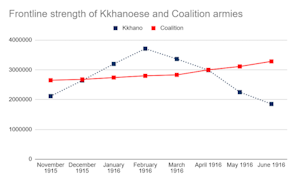
Understanding that if Kkhano was going to win the war they had to do it now the empire began preparing for multiple, simultaneous, large scale offensives, reminiscent of the events of 1913. However, to this point Kkhano had been unable to close any of the fronts they had opened, meaning that the locations from which they could draw upon reinforcements were few and far between. Aside from the forces in Norðen who retreated in December 1915 troops with any amount of experience could only be found in the reserves or garrisons, both of which were stripped extensively for the upcoming offensives. The remainder of Kkhano’s extra forces came from a recruitment drive throughout the Winter of 1915; in one of the most rapid increases in personnel size in history over one and a half million new recruits joined the Kkhanoese army in this period.
As March of 1916 began Kkhano amassed their forces across every front of the war and began attacking. These offensives saw remarkable success at first as Kkhano collectively advanced hundreds of kilometres; success was short lived however as after intense fighting Kkhanoese advances ground to a halt by the Summer of 1916. Kkhanoese losses during these offensives were immense and the empire’s pre-existing supply issues made these gains unsustainable. Compounding this issue was the terrain; after three years of nearly static frontlines the land being captured was now mostly shell-torn and levelled, rendering the train and truck infrastructure needed to supply the frontlines unusable.
Various offensives were launched over the course of the Spring but each subsequent attack became less effective as supply issues compounded and resources dwindled. In May the final major Kkhanoese offensive operation was launched in an attempt to take Ligura from Italian Canada; the combined Italo-Canadian and Svalbardian force was able to repel this attack with minimal territorial or personnel losses, and the subsequent counterattack shattered Kkhanoese morale.
Global Coalition advances
Once Spring came to an end it became clear that the Coalition held the advantage and needed to use it. As Coalition forces began to advance in June the Kkhanoese army fell back to defensive positions, aiming to delay the fall of Kkhano’s non-Wasaruan territories as long as possible so as to make a last stand in the heartlands of the empire possible. In a reflection of Kkhano’s strategies earlier in the war the Coalition left most frontlines lightly guarded and pooled most of their best forces into a single front, eliminating them one at a time; the only country that didn’t participate in these collaborative offensives was Impeck who elected to retain their whole army in their own territory, making gradual progress up Wasaru during this time.
The first of these assaults began in Glestonoph, with Meridian forces capturing Khorasan and Farsi in a few weeks whilst international forces marched south and secured the outlying islands by the end of Summer 1916; next was Dissopoloforia, largely secured by Jadefall who by this point had amassed the largest military in the Coalition allowing them to secure the continent by the Spring of 1917; after this the Obsidian Isles were secured — Svalbard, Jadefall, and a rebuilt USSNDR led naval campaigns across the isles however Anterian and Obsidian rebels also pushed out many Kkhanoese forces; finally was the Wasari campaign, led by Grenopia and Italian Canada resulting in a Coalition victory by December 1917.
The Coalition was assisted in all of these campaigns by rebel groups who by this point could easily overpower the beleaguered, unmotivated, and severely thinned out Kkhanoese garrisons. Additionally the Coalition’s armies were far more technologically advanced than their opponent’s by this point, with motorised and armoured units supporting their giant infantry armies making gains far easier to consolidate.
Final stand and capitulation of Kkhano
Over the course of the last year and a half the Kkhanoese military managed to recoup as many soldiers as they could from the other theatres; those who made it back were reassigned to either the northern or southern Wasaruan fronts, creating a significantly more formidable defense than anything the Coalition had been dealing with recently. Having lost many territories on the periphery of the continent already, Kkhano spent 1917 setting up two last defensive holds, the Monliu and Ufralst Lines, from which they would attempt to indefinitely hold out against the Coalition. Despite these hopes when the general staff met in Syr Dárya in January 1918, the final such meeting that would ever occur, a consensus was reached that winning the war conventionally was ‘unfathomable’ at this point.
By this point the Kkhanoese leadership was divided into two camps: pragmatists wished to sue for peace now under the assumption that a negotiated settlement would allow Kkhano to keep existing in some form, in contrast to waiting for their inevitable demise and annihilation when the Coalition marched on Syr Dárya. Opposed to them were hardliners whose belief was that any surrender would see the end of integralism, at least in its current form, an outcome which to them was unacceptable; instead they argued that if Kkhano could hold out in Wasaru for multiple years the Coalition would be hit by the same war-weariness and logistical issues that had plagued Kkhano previously, turning the war back in their favour. The debate was fairly even albeit slightly skewed in the pragmatists favour initially, however in perhaps the most influential single event in the closing year of the war Director of State Linen Mítlis returned from his reclusiveness to support the hardliners, before promptly disappearing once again. With Mítlis’ intervention the hardliners secured control of the government for the remainder of the war; the Coalition had been spending envoys to make peace overtures but with the hardliners now in control these were rebuffed as it was now understood the war could only be a total victory or total defeat for Kkhano.
The Coalition thus began a final assault on Kkhano which would last throughout 1918: in coordinated simultaneous strikes Kkhanoese positions on both the Ufralst and Monliu lines were attacked, which despite the slow rate of progress thanks to Kkhano’s numerical advantage did steadily fall. When these positions fell the Kkhanoese army did attempt counterattacks but to no avail and at a heavy cost; thousands would die and tens of thousands taken prisoner in each of these attacks which were losses Kkhano could not replace with their ever dwindling industrial and population base, the complete lack of aerial or naval support made Kkhano’s already outmatched army even more hopeless.
Eventually the proverbial dam would burst in December 1918 as the Impeckan army secured a breach in the Verleschidian town of Medvenburg, quickly advancing up to Medalltut and encircling around half of the southern Kkhanose forces in Noddenlund and Driyv Smye. After the battle of Medvenburg the Kkhanoese leadership accepted that defeat was inevitable, despite their previous hardline views, and began preparing for an official surrender.
Kkhanoese leadership attempted to negotiate in January but were rebuffed by the Coalition — primarily down to Impeckan influence, whose military junta under the leadership of Hor-Qa Mbuwanda wanted to reach Syr Dárya first which he believed would give his country a better negotiating position. The lack of a forthcoming peace deal greatly frustrated what remained of the Kkhanoese military, most of the soldiers by this point becoming disillusioned with the ideological motivation for the war and now wished to return home to their families. The great mutiny of February 1919 shattered what remained of Kkhano’s frontline allowing Impeck to conduct their march on Syr Dárya. This mutiny led to most of the Kkhanoese leadership resigning or otherwise abandoning their posts to go into exile; the most senior figure who remained was Brigadier General Bence Endre and it was ultimately him who signed Kkhano’s surrender after the fall of the capital on the 25th of February.
Aftermath
Immediate consequences
Since 1860 it had seemed as if Kkhano’s eventual conquest of all of Utopia was inevitable; an entire generation grew up in a world where one state would come to directly control over 75% of all land in the world. In one war all of this was reversed; in under a decade Kkhano’s empire disappeared along with them the systems of government and values they had brought along with them: it is no exaggeration to say that the War of the Third Coalition was the single most transformative conflict in human history.
Additionally the war left many areas of the world ravaged; hundreds of villages, towns, and cities were levelled across every front of the war along with millions of casualties across both sides. Many previously bustling population centres were left depopulated and flattened to rubble; uncoordinated rebuilding efforts meant many of these places remained in this state for decades after the war, some never recovering to their pre-war state even to this day.
Economic and political impacts
The extent of conscription and casualties that came from fighting left the workforces of many nations depleted in ways not seen since global pandemics such as the Great Plague; in a reflection of that event the remaining workforce had greater bargaining power as labour was at a premium for employers, leading to them being able to demand higher wages and better conditions. Furthermore with so few workers available many nations in the Coalition were forced to rely on previously discriminated sections of society to plug the gap; women and minorities’ share of the workforce grew exponentially in the non-Kkhanoese world at a record rate. These demographic shifts in the workforce contributed significantly to the advancement of these groups' rights in the 20th century, ironically accelerating the social egalitarianism Kkhano had weaponised against the world during their rise to power.
Similarly government control over many aspects of society, but in particular the economy, also skyrocketed during and after the war: the War of the Third Coalition has been described as the first total war in Utopian history which necessitated the entirety of society mobilising in support of the war effort. To this end government spending as a share of GDP rose dramatically in all countries, exceeding 50% in all participating nations and nearing 75% in Kkhano, the Meridian Commonwealth, and Impeck. This trend gave governments around the world a greater level of control over their economies, and by extension their politics. Economic control was leveraged in nations such as Grenopia and Impeck to accelerate their authoritarian transitions which had begun before the war, meanwhile pre-existing totalitarian states like Kjanu and Jadefall further tightened their control.
The excessive spending that was needed to fund the war was more often than not financed with debt; with most nations on the frontlines however the options for lenders were minimal. Countries who had large economies that were largely shielded from the effects of war, namely Italian Canada, Svalbard, Jadefall, and the non-participating Quziq leant most of the money throughout the conflict. Collectively these four nations were owed over $50 billion by the war’s end and began demanding repayments in 1920, mainly funded by reparations from Kkhano, but it took multiple decades for these payments to be fully repaid in part because of the economic devastation across much of the world, but compounding this geopolitical tensions disincentivised repaying loans, especially if they were to diplomatic rivals.
Societal impacts
The totality of war put the reality of conflict in the public’s eye in a way never quite before seen. The thousands of kilometres of trenches dug cut through cities and towns and brought the consequences of war directly to civilians, even if a settlement wasn’t on the frontlines it likely was still subject to bombing raids or naval blockade at one point or another. The horrors of the war led to a noticeable shift in the cultural zeitgeist; the romanticist age of art, which had been declining since Kkhano’s rise to power, was ended by the war as people became disillusioned with the romantic worldview and instead wished for art to more closely depict life as it was, leading to the rise of the avant-garde movement among others.
The lives of soldiers who served in the war were also permanently altered; conditions in the trenches led to never before seen ailments both physically, such as trenchfoot, and mentally, including PTSD (colloquially referred to as ‘shell shock’ at the time). These injuries consequently made returning to normal life very difficult for surviving soldiers, as their physical conditions hindered their ability to do work whilst psychological trauma caused them to struggle communicating their issues. Soldiers returning home often formed veterans’ associations as they found they could only talk about their experiences with each other; in response to this medical associations were forced to change their practices to ensure patients would be able to reintegrate into society after treatment, leading to a rise in therapy.
Pacifism grew greatly during the war as the extent of fighting brought more people into conflict than ever before in history, leading to many people who normally wouldn’t be involved in warfare being asked to contribute directly. On political, religious, or moral grounds tens of thousands of people across the world refused to serve and became known as conscientious objectors, often facing harsh punishments for doing so including imprisonment or forced service (depending on their country of origin). For a while conscientious objectors continued to face persecution in many countries but as time wore on and new wars broke out pacifist movements became increasingly mainstream across Utopia; openly pacifist politicians like Ranhaus Bodker in Svalbard would come to win elections and eventually begin a more peaceful era in Utopian history.
Formal end of the war and peace treaties
Although Syr Dárya fell on February 25th 1919 and a ceasefire was signed on the same day technically a state of conflict persisted between Kkhano and the Coalition until October 13th of the same year when the Treaty of Titel concerning Wasaru was signed. Every individual signatory had to ratify the treaty leading to the war officially ending at different dates in every country in the world: of the Coalition’s official members Svalbard took the longest to formally end its involvement with the ‘Cessation of Hostilities Act 1929’, a full ten years after fighting had ended. Despite these technicalities most war memorials recognise the end of the conflict as February 25th 1919 as this is when large-scale organised fighting ended, also coinciding with when countries began demobilising and soldiers started returning home.
The Coalition members met along with various concerned rebel groups in Pailān to discuss terms for peace, however Kkhano’s empire was so vast that multiple treaties needed to be drawn up to deal with different parts of the empire which ended up being discussed in various locations across Grenopia’s Titel palindromic bit. It’s for this reason that the treaties are collectively referred to as the Titel Peace Accords (or just treaty) rather than the Treaty of Pailān.
Negotiations began with all present parties agreeing to key principles underpinning the peace treaties. These would be:
- That Kkhano was solely responsible for the outbreak of war, as well as all of the deaths and damages that came from it.
- That the victorious powers would commit to suppress global integralist sentiments.
- That no signatory nation should attempt to grow their influence at the expense of the others, or otherwise attempt to dominate the world in the same vein as Kkhano had.
- That Kkhano would pay reparations to the victorious powers where territorial gains are not sufficient compensation for losses caused by the war.
These four points were broadly agreed upon and proved uncontroversial within the Coalition and rebel groups; Kkhanoese delegations naturally protested however due to how the war ended their voice was meaningless and terms would ultimately be dictated to them.
For aforementioned reasons separatist rebels were sidelined unless their demands were irrefutable in light of their military might (such as in the case of Northern Czech and Anteria) or didn’t overlap with the demands of leading Coalition members (as happened in Glestonoph and the Ákaltar Ocean islands). Rebel groups had less influence over the specific terms of all treaties and were invited to send less delegations (if any) to meetings than the leaders of the Coalition, which led to the first of many points of friction at the peace conference.
Unity amongst the Coalition’s leaders would also be short-lived however, as the conflicting ideologies between different member states would begin to emerge and create divisions. The primary divide was between more imperial members — led by Jadefall and including Impeck, Kjanu, and Grenopia — and those who preached self-determination — Svalbard and the Meridian Commonwealth. Arguments between these two sides complicated negotiations and delayed the implementation of treaties; whilst generally the imperialists were stronger in negotiations they were also usually more self-interested and struggled to put up a united front against so-called self-determinisationists. Imperialists pointed to the second key principle of the peace treaties to justify their expansions, arguing that smaller states not supervised by Coalition members couldn’t stem simmering integralist support: this argument however would be undermined by revolts across Jadefallian occupied Dissopoloforia in 1920, leading to both sides agreeing to a compromise.
Italo-Canadian president Luzio Drahgi would ultimately present the solution that would solve the negotiations: the procuratorate system would grant autonomy to the people liberated from Kkhano whilst assigning a Coalition member as an overlord to oversee each of these states. This was enough to placate both sides of the debate, although Svalbard and the Meridian Commonwealth would decline offers to lead a procuratorate themselves. The result of this system was a strange mix of the establishment of some new, semi-independent states along national identity lines within new and re-established empires. This confusing and often contradictory new world would go on to be the backdrop of the modern world.
Provided by sam_gaming(User)